

qdpg.over-blog.com/
24 Janvier 2021

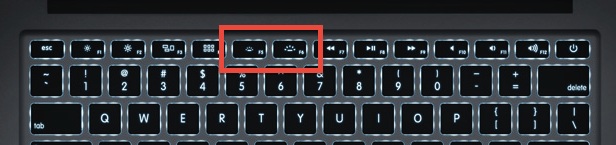
The F5/F6 defaults to the backlight adjustment function. After long press FN+K+C for 3s, the keyboard will flash 3 times, then the function of F5/F6 will switch to the normal F5/F6 function under Mac system, and the keyboard backlight control will adjust to FN+F5/F6. The F5/F6 defaults to the backlight adjustment function. After long press FN+K+C for 3s, the keyboard will flash 3 times, then the function of F5/F6 will switch to the normal F5/F6 function under Mac system, and the keyboard backlight control will adjust to FN+F5/F6. Mar 29, 2007 On my PC, I think I hit F4 or F5 and the Microsoft Powerpoint presentation switches from Normal viewing mode to Presentation mode. On my macbook pro (core 2 duo), I have my volume button on F5 and Fn+F5 doesn't seem to do it. Side note: Fn+F6 is very useful. Brightness keys (F1, F2): Press or to decrease or increase the brightness of the screen. Mission Control key (F3): Press to view what's running on your MacBook Air, including all your spaces and open windows. Launchpad key (F4): Press to instantly see all the apps on your MacBook Air. Click an app to open it. Keyboard illumination keys (F5, F6): Press or to decrease or increase the. MacBook Pro- new, Mac OS X (10.5.2), lives with PowerBook 540c, 160 and a Newton 2000 Posted on Jun 24, 2008 5:23 PM Reply I have this question too ( 185 ) I have this question too Me too (185) Me too.
You can use these keyboard shortcuts to control accessibility options, or ask Siri to perform these functions. For example, ask Siri to 'Turn VoiceOver On.'
| Action | Shortcut |
|---|---|
| Display Accessibility Options | Option-Command-F5 or triple-press Touch ID (power button) on supported models1 |
| Turn VoiceOver on or off2 | Command-F5 or Fn-Command-F5 or hold Command and triple-press Touch ID on supported models1 |
| Open VoiceOver Utility, if VoiceOver is turned on2 | Control-Option-F8 or Fn-Control-Option-F8 |
| Turn zoom on or off3 | Option-Command-8 |
| Zoom in3 | Option–Command–Plus sign (+) |
| Zoom out3 | Option–Command–Minus sign (-) |
| Invert colors4 | Control-Option-Command-8 |
| Reduce contrast | Control-Option-Command-Comma (,) |
| Increase contrast | Control-Option-Command-Period (.) |
1. MacBook Pro (15-inch, Late 2016), MacBook Pro (13-inch, Late 2016, Four Thunderbolt 3 Ports)
2. To use VoiceOver and VoiceOver Utility, you might need to turn on 'Use all F1, F2, etc. keys as standard function keys' in Keyboard preferences. You might also need to make VoiceOver ignore the next key press before you can use some of the other Mac keyboard shortcuts.
3. To use the zoom shortcuts, you might need to turn on 'Use keyboard shortcuts to zoom' in Accessibility preferences.
4. To enable this shortcut, choose Apple menu > System Preferences, then click Keyboard. In the Shortcuts tab, select Accessibility on the left, then select 'Invert colors' on the right.
You can use your keyboard like a mouse to navigate and interact with items onscreen. Use the Tab key and arrow keys to navigate, then press Space bar to select an item.
| Action | Shortcut |
|---|---|
| Switch between navigation of all controls on the screen, or only text boxes and lists | Control-F7 or Fn-Control-F7 |
| Move to the next control | Tab |
| Move to the previous control | Shift-Tab |
| Move to the next control when a text field is selected | Control-Tab |
| Move the focus to the previous grouping of controls | Control-Shift-Tab |
| Move to the adjacent item in a list, tab group, or menu Move sliders and adjusters (Up Arrow to increase values, Down Arrow to decrease values) | Arrow keys |
| Move to a control adjacent to the text field | Control–Arrow keys |
| Choose the selected menu item | Space bar |
| Click the default button or perform the default action | Return or Enter |
| Click the Cancel button or close a menu without choosing an item | Esc |
| Move the focus to the previous panel | Control-Shift-F6 |
| Move to the status menu in the menu bar | Control-F8 or Fn-Control-F8 |
| Activate the next open window in the front app | Command–Grave accent (`) |
| Activate the previous open window in the front app | Shift–Command–Grave accent (`) |
| Move the focus to the window drawer | Option–Command–Grave accent (`) |
To use these shortcuts, first press Control-F2 or Fn-Control-F2 to put the focus on the menu bar.
| Action | Shortcut |
|---|---|
| Move from menu to menu | Left Arrow, Right Arrow |
| Open a selected menu | Return |
| Move to menu items in the selected menu | Up Arrow, Down Arrow |
| Jump to a menu item in the selected menu | Type the menu item's name |
| Choose the selected menu item | Return |
When Mouse Keys is turned on, you can use the keyboard or numeric keypad keys to move the mouse pointer.
| Action | Shortcut |
|---|---|
| Move up | 8 or numeric keypad 8 |
| Move down | K or numeric keypad 2 |
| Move left | U or numeric keypad 4 |
| Move right | O or numeric keypad 6 |
| Move diagonally down and to the left | J or numeric keypad 1 |
| Move diagonally down and to the right | L or numeric keypad 3 |
| Move diagonally up and to the left | 7 or numeric keypad 7 |
| Move diagonally up and to the right | 9 or numeric keypad 9 |
| Press the mouse button | I or numeric keypad 5 |
| Hold the mouse button | M or numeric keypad 0 |
| Release the mouse button | . (period) |
When Apple designed the MacBook keyboards, they were probably thinking of which commands we will be using the most when they assigned shortcuts to specific functions, but as with everything else that is being used by millions of people, actual usage does not always align with intended purpose, so many default keys are left unused while some missing keys remain desired. If you have a lot of unused keyboard shortcuts yourself and would like to replace their functions with something that you actually use, below is a guide on how to remap keys on your Mac.
There are several sets of keys on your Mac keyboard that perform individual functions. You can modify the functions of some keys, but there are some that you cannot. Among the sets of keys that the functions of which you can easily change and remap according to your needs are the function and modifier keys.
The function keys are usually located at the top most part of your keyboard and are either marked with a letter F followed by a number (e.g. F1, F2, F3, etc.) or an icon that signifies what they do (e.g. sun icon for brightness and speaker icon for volume).
The modifier keys, on the other hand, are the sets of keys that you use in combination with another key to perform specific functions like the CMD, CTRL, Caps Lock, Shift, and Option keys.
Traditionally, Function keys were designed to work as shortcuts to system-related commands usually buried under convoluted menus and submenus; however, since they are not frequently used by the average user, Function keys have been increasingly remapped to provide quick access to basic customization tools (like brightness or volume control) although their traditional functions have not been completely removed but simply delegated to the backseat instead.*
For example, in the current Mac keyboard design,
*To use the traditional functions of the Function keys, you have to press F1 or F2 together with the Fn key.
**F5 and F6 has no specific function attached to it by default.
Like Function keys, modifier keys also work as keyboard shortcuts to frequently used commands. Some examples of commands that your modifier keys are assigned to perform by default are:
Aside from being used as keyboard shortcuts for system-wide commands, modifier keys can also be used to execute application-specific commands like:
If you are not happy with the default functions of your Function and Modifier keys, you can easily remap the keys on your Mac to assign keyboard shortcuts according to your specific needs and preferences.
To remap the Function keys and change how they work, Microsoft office for macbook air 2019.
Go to the Apple menu
To remap the modifier keys and assigned new key combinations for shortcuts,
This works for system-wide commands; however, you can also remap keys to perform certain functions while particular certain apps.
To do this,
Just make sure that the new keyboard shortcut that you created isn't already assigned to another command. Otherwise, it's not going to work unless you will change the shortcut that was created first. If you don't know which keyboard shortcuts have already been assigned to which commands, you can use this detailed list for reference.


/image%2F6318778%2F20210327%2Fob_689b01_online-3d-design-software.jpeg)
/image%2F6318778%2F20210327%2Fob_b670da_what-kind-of-software-is-excel.jpeg)
/image%2F6318778%2F20210327%2Fob_1b3667_apple-computer-watch.jpeg)
/image%2F6318778%2F20210327%2Fob_19a187_microphone-editing-software.png)